




Front Service vs. Rear Service: Which Is Better for Your LED Display?
When it comes to LED display installation and maintenance, your top priority is always reliability, visual quality, and smooth operation. Whether the LED screen is lighting up a retail store, controlling a mission-critical operation center, or catching eyes in a busy city square, how you maintain your LED display impacts everything—from performance and aesthetics to long-term cost.
Both front service and rear service are proven approaches for keeping your LED screens up and running. But which is truly best for your needs? This is a common question for both newcomers and seasoned industry professionals.
So, in this post, I’ll dig deep into the “Front Service vs. Rear Service” debate. You’ll get a clear understanding of what each method offers, their differences, and practical tips on how to choose the best fit for your LED project—so you can make an informed decision for your display’s long-term success.
Ready to get started? Let’s dive in.
In This Article
Introduction
LED displays have become the visual heartbeat of our built environment. From colossal outdoor billboards crowning city skylines to sleek, wall-flush lobby screens, from immersive retail façades to mission-critical control rooms, LEDs deliver brightness, color fidelity, and dynamic content with remarkable efficiency. Yet behind the pixels lies a decision that quietly shapes the entire lifecycle of your screen: how you will maintain it.
While specifications like pixel pitch, brightness, and refresh rate tend to dominate selection conversations, the maintenance method—front service or rear service—is just as crucial. It determines where you can physically install a screen, how fast you can resolve faults, how much structural space you must allocate, how your team will work safely, and ultimately, what your total cost of ownership (TCO) will be over years of operation.
Generally, when it comes to the maintenance of LED screens, there are two popular methods: front service and rear service.
What Is Front Service?
Front service is a single and direct maintenance method engineered for environments where space behind the LED display is limited or entirely unavailable. With front service, technicians perform all maintenance actions—module replacement, power and signal access, and fine adjustments—from the front of the screen.
Currently, the main ways to achieve front service are to use magnetic mounting screwsor front fixed screws (mainly for outdoor screens).
1. Magnetic Mounting Screws
This is the most common method for indoor LED displays.
The core enabler is a magnetic mounting system. Each LED module is designed to be magnetically attached to cabinet structures using strong magnets and is typically paired with a mechanical lock or “anti-drop” feature to guard against accidental detachment. This design allows modules to be installed quickly and held securely, while also making it possible to remove a single faulty module for service without accessing the back.
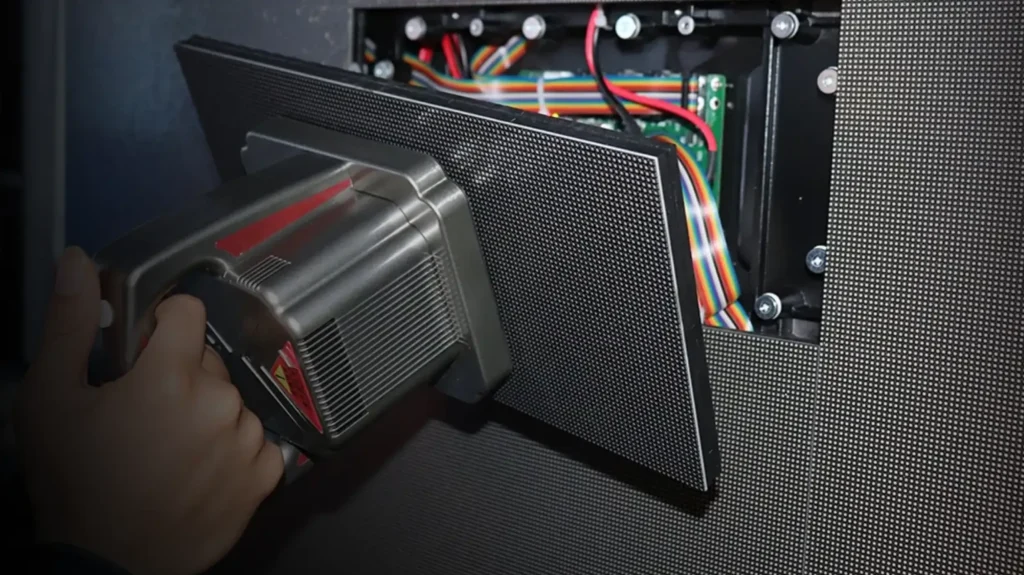
Simple explanation: Think of front service like replacing a tile on a finished mosaic without removing the wall. You use a specialized suction tool to lift the single tile (module) straight out from the front, swap it, and set it back into the exact place—no need to get behind the wall.
The magnetic design makes removal quick and easy, and modules snap back into place with minimal effort, ensuring installation remains flat and precise.
2. Front Fixed Screws With Rotary Wrench
For larger, more robust outdoor LED screens, front service is often accomplished using front fixed screws in combination with a rotary wrench.
Here, each LED module is fastened from the front with special screws that can be removed with a dedicated rotary wrench. This design ensures each module remains secure and stable, even in challenging weather conditions.
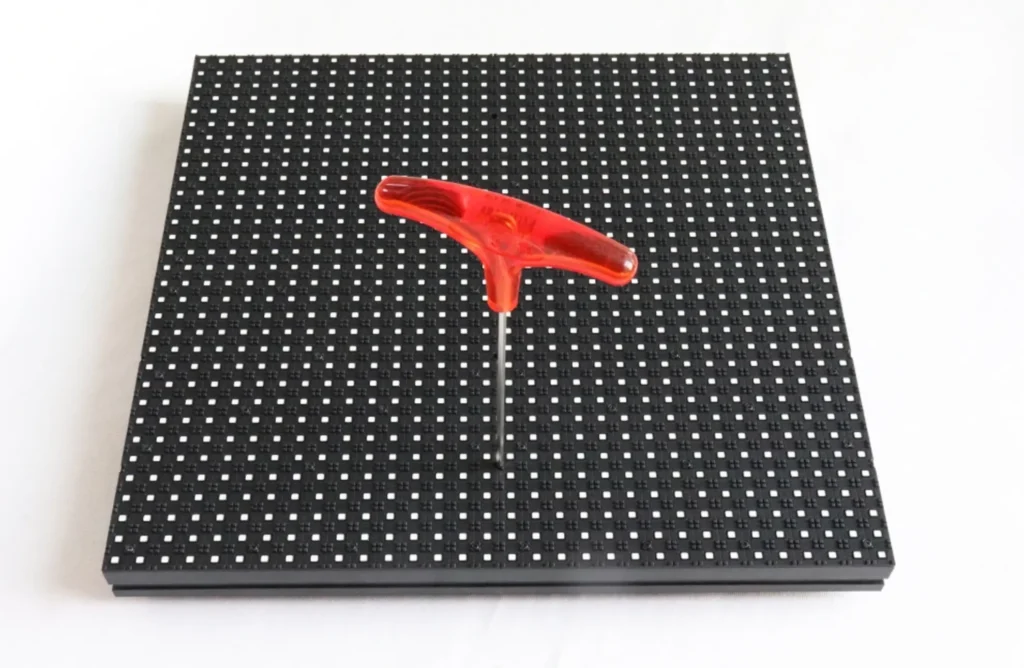
If maintenance is needed, a technician accesses the screws from the front, loosens them with the rotary wrench, and removes the faulty module for repair or replacement. This approach provides extra security and stability for outdoor scenarios where the display faces wind, vibration, or other environmental stress.
Both front service methods eliminate the need for rear access, offering efficient maintenance with minimal disruption and unlocking new possibilities for where and how you install your LED display.
Where front service fits best:
- Tight, wall-flush installations (e.g., TV Studio, churchs, hotel and retail feature walls).
- Embedded or recessed applications like glass curtain walls, where back access is impossible.
- Complex shapes—curved, cylindrical, or custom architectural integrations—where a “back side” is either inaccessible or doesn’t exist in a usable way.
- Spaces where visual integration and architectural cleanliness are prioritized, and opening a rear maintenance room or corridor would compromise the design.
In short, front service is your go-to solution when the screen must live up close and personal with the built environment, where back access is impractical and every millimeter of depth matters.
What Is Rear Service?
Rear service is the traditional LED maintenance approach.
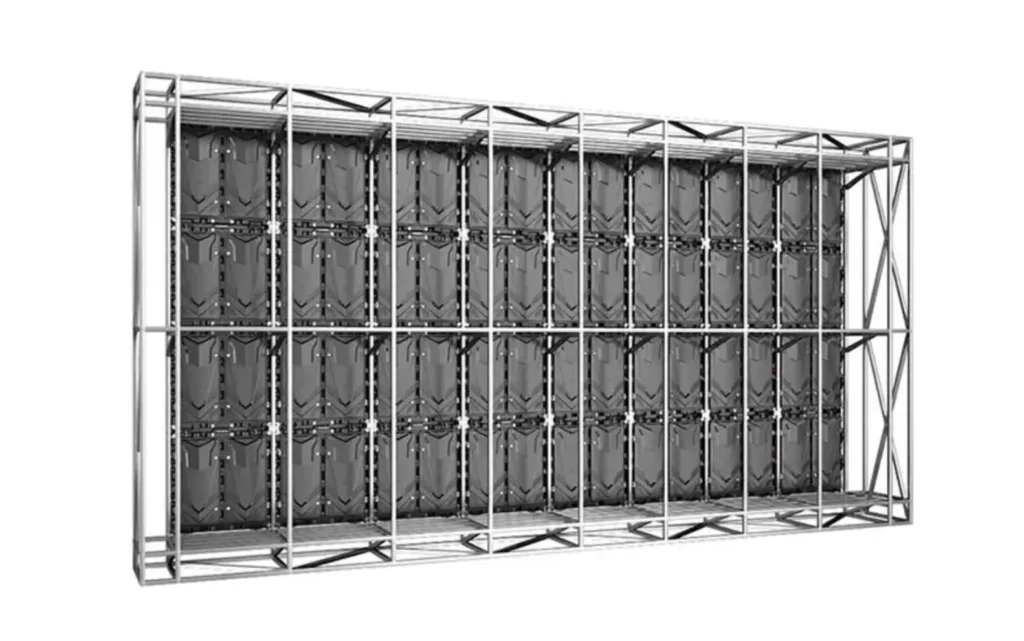
It assumes that technicians will access and service the screen from behind, which requires a dedicated maintenance corridor or backstage area large enough for safe movement and work.
Typical rear clearance requirements are on the order of 60–80 cm (or more), depending on the structure and local safety practices.
Technicians enter this space to unbolt and remove modules, power supplies, or receiving cards from the rear of cabinets. Cabinets are secured via mechanical fasteners—screws or bolts—onto robust steel frames that are designed to handle weight, wind loads (outdoors), and long-term structural stability.
Where rear service fits best:
- Large outdoor billboards and rooftops with dedicated steel structures and safe back access.
- Control centers, broadcast walls, and facilities that can provision a planned maintenance corridor.
- Indoor installations with generous architectural space where a rear room or aisle is feasible and safe.
If your site can afford the architectural space and you want the proven stability and familiarity of traditional installations, rear service often remains the logical, cost-effective choice.
The Difference Between Front Service and Rear Service
Here’s a detailed comparison to spotlight the core differences.
| Feature | Front Service | Rear Service |
| Maintenance Direction | From the front of the display | From behind the display |
| Space Required | No rear space needed; can be wall-mounted | Requires rear access/corridor for maintenance |
| Typical Scenario | Indoor (walls, tight spaces); creative shapes | Large outdoor screens; rooms with rear access |
| Module Removal Method | Magnetic mounting screws or front fixed screws with rotary wrench | Unfasten modules from the back using traditional screws/bolts |
| Installation Complexity | Usually simpler; direct access to modules | Structure and corridor planning required |
| Aesthetic Integration | Enables flush or embedded installations | Often requires visible frame or access space |
| Speed of Maintenance | Fast (front suction tools, rotary wrench) | Slower; more steps to reach faulty modules |
| Cost | Slightly higher due to specialized components | Often lower product cost, higher structure cost |
| Suitability | Best for limited or zero rear access locations | Ideal where rear access is feasible and safe |
| Environmental Security | Magnetic/locking system, front screws (outdoor) | Traditional bolts, more robust against tampering |
| Heat Dissipation | Needs careful design for airflow (wall flush) | Easier rear ventilation management |
The Pros and Cons of Front Service and Rear Service
Pros and Cons of Front Service
| Pros | Cons |
| Allows maintenance from the front, no rear access needed | Usually higher initial product cost due to special design |
| Ideal for wall-mounted, embedded, or tight spaces | Magnetic modules may be less robust against vibration (indoors only) |
| Faster and easier module replacement; less downtime | Precision installation needed to ensure flat, seamless surface |
| Enables creative shapes and flush installations | Heat dissipation requires careful design in wall-flush installs |
| Less disruption to building structure or existing design | For outdoor: installing/removing front screws can be slower |
| Usually requires only one technician for module swap | Specialized tools (suction cup, rotary wrench) required |
Pros and Cons of Rear Service
| Pros | Cons |
| Heavy-duty structure, strong stability-better wind/vibration resistance | Needs maintenance corridor/space behind the screen |
| More cost-effective product and cabinet for large/outdoor screens | Not suitable for wall-flush or tight installations |
| Traditional screw/bolt fixing is secure and familiar | Module replacement takes more time and labor |
| Excellent heat dissipation via rear ventilation | Maintenance may cause disruptions backstage |
| Easier to manage and maintain large-scale or outdoor LED screens | Multiple technicians may be needed for safe rear work |
| Simpler structure for robust environments | Access is more challenging for creative shapes or designs |
How to Choose the Right Maintenance Method for Your LED Display
Now, we have learn the pros and cons of front service and rear service. You might wonder: how to choose the right one for my next LED display?
Use this simple decision path to narrow your choice quickly:
1. Do you have usable rear space?
- If “no,” choose front service. The absence of a safe, accessible corridor effectively mandates it.
- If “yes,” both options remain viable; proceed to functional priorities.
2. What matters most in your environment?
- Maximum structural stability and lowest initial product cost: Favor rear service, especially in large outdoor or industrial contexts.
- Minimal downtime and fast, uncomplicated maintenance: Favor front service; one-person module swaps from the front can be a decisive operational advantage.
- Architectural integration and aesthetics: Favor front service for wall-flush, recessed, or creative shapes.
2. Budget alignment
- Front service typically carries a 5–10% product premium. If your budget is tight and space permits, rear service can free funds for pixel pitch, content systems, or other value-adds.
- If lifecycle costs and operational continuity are paramount, front service may offset its premium via lower maintenance labor and reduced disruption over 5–8 years.
Scenario-based guidance:
- Retail flagships and hospitality lobbies: Front service—space is at a premium and aesthetics drive value.
- Control rooms and broadcast walls: Either can work; if a rear corridor is planned, rear service is viable; if fast front access and minimal disruption matter most, front service is attractive.
- DOOH billboards and rooftops: Rear service—robust structures, proven stability, and easy airflow typically win.
- Creative shapes (cylinders, curves, spheres, cubes, embedded façades): Front service—front access is often the only practical approach.
Conclusion
In this post, we examined the difference between front service and rear service for LED displays through their core concepts and features. We showed how space constraints, maintenance speed, aesthetics, and long-term operations shape the choice more than any single spec number. We compared their Advantages and disadvantages, highlighted where each one thrives, and provided selection guidance to reduce risk and guesswork.
If you still have questions, want help applying this framework to your specific site, or need a complete analysis, contact us. We’ll help you match the right maintenance approach to your environment so your LED display delivers the performance, reliability, and visual impact you expect—on day one and for years to come.